It has been a while since I have written a blog post; however, I have been thinking about and talking about how teachers interact with AI over the last two years and felt the need to put a few things down in writing.
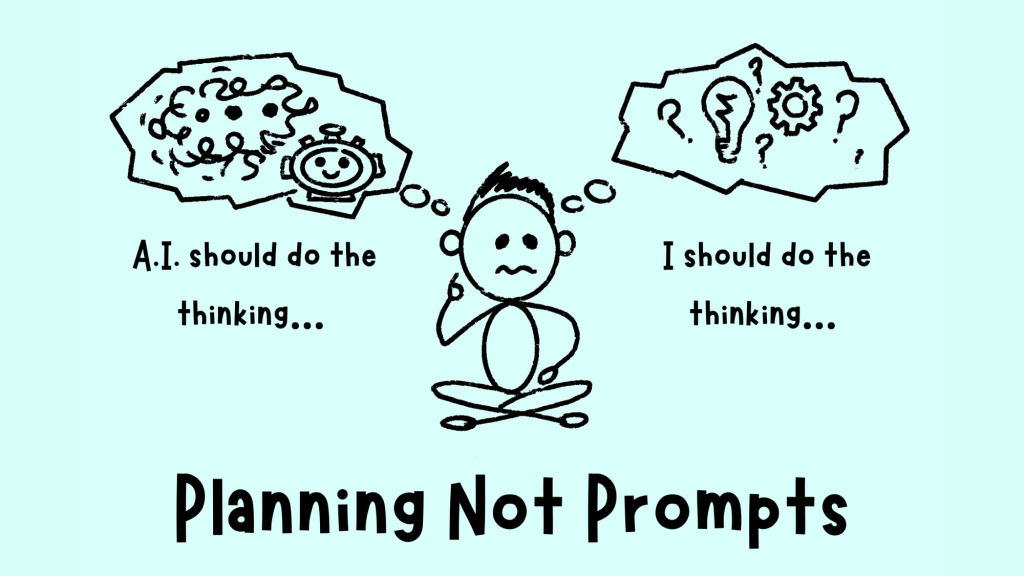
There’s obviously a huge amount of discourse out there already, so it firmly comes from a curriculum task design perspective and how, as teachers, we ensure effective pedagogy, teaching and learning whilst still embracing innovation. AI is quick, and it is incredibly tempting, particularly when we are time poor, so why wouldn’t we embrace it, why wouldn’t we encourage the profession to find a way to use it effectively? However, we need to be very careful that we don’t subcontract out our thinking and confuse generated ideas with actual planning, because it isn’t.
Before
Before AI, there was a process; it wasn’t a perfect one, however, there was a tested process. Student teachers were expected to listen to theory and research from practitioners experienced in planning and delivering high-quality content. Then, when out ‘in the field’, they would start their own journey of planning a lesson. This required a lot of trial and error. First, you would spend the inevitable time researching, searching and writing your lesson plan. You’d then get your presentation or materials ready. You would deliver the lesson. It would either be ok, great or terrible; in any case, you would receive feedback. With this feedback, you would then try again. This is an incredibly important step; it allows you to refine the expectations of a lesson and understand, from a very basic and initial perspective, how children learn. This is naturally from my experience from my PGCE, and not everyone will have experienced the same; however, it will be similar in any initial teacher training.
Whilst I dislike and deride the ‘3 part lesson plan’, it provides an opportunity to practise, to think through and to develop your skills as a lesson planner. Then you test-drive the approach as a teacher. I will not go into particular approaches because there are many and a lot of opinions, and these can sometimes be quite polarising. However, I will acknowledge that in all my training now, I use the same phrase over and over: “You have to do the maths.” I don’t mean this literally, and it comes from a leader I work with, and it is appropriate now more than ever in this AI-centred education world. It is useful, of course it is. I can generate sentences for spelling practice, definitions for words that are at a specific reading level, alternative explanations that may resonate more with certain children and an endless number of model texts to use in English instead of writing my own.
However, the bottom line is that teachers early in their career do not need detailed, generated plans. They need to learn clearly how planning works.
If You’re Thinking Hard, Then They Are Thinking Hard
Another way in which I use the same concept and idea is the idea that if we are thinking hard about our content and lesson planning, then there is some transference. Children will have experienced a lesson that has been well thought out by experienced practitioners, and therefore they will think hard as a result. This is essentially my one big takeaway from my task design training, or ‘approach’ as some people call it. I just refer to it as being more aware of the overall expectations and outcomes.
Here is where I begin to worry. On a daily basis, I see ads on my social media feed targeted directly at teachers from teachers, most early in their career, as they manage the world of ‘teacher influencing’, selling what appears to be the almighty magic silver bullet. This wonderful tool will save you time, be incredibly quick, editable and engaging.
The reality is very different. I am not here to talk down AI or the tools that are being advertised, and whilst I think there is a strangely aggressive way in which they are advertised, there appears to be a race to grab any new AI tool or start using one, often without the consideration of whether it is actually useful or even worth it. They all come with a ‘freemium’ price model, which is the norm. You pay nothing, get a certain amount of free things, with the option to extend. Again, all this is not the issue.
Full disclosure, I work with a platform that does a very similar thing. So, as Head of Learning for Chalk Learning, I can completely see the value in all of these tools. However, what I feel Chalk does that others don’t is that we are fully keeping teachers in the loop. It is not a full lesson package or one-stop shop for lesson plans, slides and resources. What it is, though, is a space for thoughtful visual thinking tools.
The Useless and The Useful
Let’s stay with a bit of devil’s advocate. Take, for example, the humble WAGOLL (What A Good One Looks Like). We can now simply type:
“Acting in the role of an experienced primary teacher teaching Year 6, can you create a model information text about volcanoes, including clear subheadings, bullet points and using a number of words from the Year 5 and 6 statutory spelling list”
– the result of which is below 👇
Incredibly, you can get this done in a few seconds, and no one would argue this. Putting aside the environmental impact and energy consumption for a minute, take some time to think about the problem with having never had the opportunity to write a WAGOLL. Would you accept that it sounds good, so it must be? Would you be happy with your class using it as an acceptable model? Is it accessible for all children, or does it set a particular expectation?
Now, I trained and taught from a point in time where we had to write our own models; sometimes, we did a shared write where I literally typed or wrote on the board as the children shared ideas, and I still do. However, now we risk subcontracting that thinking out to a machine and are also at risk of deskilling ourselves. The counter-argument is that we do the generation and then edit it before we give it to the children. Absolutely, this is certainly better. I always use the illustrative ratio of 80/20, where we do 80% of the thinking, and the machine, as a tool, helps with 20%.
I talk about this more here: Using A.I. To Support Task Design
My central point here is that if we don’t write a WAGOLL as often, do we actually know what a good one looks like? I’m not professing to have any answers here. This is definitely more rhetorical, but I think it’s important for us to ask the questions so we can determine exactly the kind of relationship we have with AI.
Spellings and definitions are also definitely admin-heavy tasks, and you can argue very coherently that reducing the time spent doing this or creating word banks will go back into more valuable pursuits. However, again, is this also something that will become an over-reliance?
Planning or Preparing
I will absolutely concede that admin tasks such as those above are 100% easier to generate and check. However, for me, curriculum thinking is absolutely not something we want to subcontract out to a machine.
This is where I think the distinction between planning and preparing really matters. Preparing is usually about what we can see. It is the PowerPoint, the task, the retrieval, the model text or the word bank. Planning is different. Planning is about asking what this lesson is for. It’s about teacher thinking and asking: what has come before, what will the children need to have secured already, what is this lesson actually adding, and what is it preparing children to understand next? That is the hard thinking. That is the part we still need teachers to do. We should not subcontract this work out.
A lesson can look complete and still be poorly planned. It can have all the right ‘features’ and still work awkwardly within a sequence. Almost all AI-generated slide decks now promise to generate an effective lesson in seconds. It can include a seemingly coherent ‘activity’ but not actually move the children towards the intended understanding. It will add pictures, icons and have a great colour scheme. I see these advertisements regularly and I have tried all of these tools. They ‘work’, but they aren’t working. Yes, they will throw together a slide deck, with suggested quizzes and pictures from a tick list you completed moments earlier, but it is not considering your class and their needs. I know that you will argue, but it is editable and the adaptation is in the teaching, of course it is. I also hear the argument that slide decks and PowerPoints are not teaching, of course this is true. Great teaching requires a teacher, a concept and children. However, my point here is if we generate the steps or moments within the lesson, we are non-thinking, so therefore aren’t planning. Which is why I keep coming back to the same point. Generated output is not the same as professional thought.
For teachers early in their career, this matters enormously. We do not get better at planning by subcontracting out the process. We get better by failing at it. By trying, refining, noticing what worked, seeing what did not, and gradually becoming more precise in how we think about curriculum and instruction. A generated lesson may appear to solve the problem quickly, you may even say, well, I chat with the AI regularly and I have shared all my key documents, but it is no better than a sophisticated predictive text. It will remove the very struggle through which better planning is learned. It is not a flaw to start off being bad at planning, it is quite literally how we get better at planning.
For teachers later in their career, the risk is similar but slightly different. It’s not about lacking the knowledge of the ‘craft’. It’s about assuming that because something looks plausible and sounds professional enough, it’s good enough. Experience helps us work quickly, but it should also make us more thoughtful and discerning. We still need to interrogate what’s in front of us. Why this content now? What is it relying on? What misconceptions might emerge? What exactly are children building towards here? Those questions don’t disappear because a machine has made the first draft, and we shrug and say “good enough!”.
For me, this is where curriculum matters most. Lessons don’t exist on their own. They are part of a longer journey or narrative which tells a much greater story of learning across a unit, a year group and a school. AI can generate a lesson skeleton, but it really cannot genuinely know what this lesson means within that journey unless a teacher has already done that thinking first. Sequence first, resource second. ALWAYS!
So absolutely, use the tools. Use them to reduce some of the friction around preparing resources. Use them to generate possibilities, alternatives and starting points. Ask it questions to get YOU thinking. But do not confuse that with planning. Don’t hand over the thinking that is the heart of our work. If anything, the rise of AI makes that thinking more important, not less.
A lesson is not well planned because it exists. It is well planned because it has been thought through in relation to the curriculum intent and with the children in front of you in mind.
This is part 1 of a trilogy on AI, curriculum and professional judgement. In part 2, I will explore task design more closely, particularly the idea that AI can suggest activities, but teachers still need to design thinking.
As always comments and criticisms are welcome. If you are yet to join our Primary Task Design Community and would like to please follow the link here 👇
https://www.facebook.com/share/g/1GW7MiCRS5/?mibextid=wwXIfr
Karl (MRMICT)


 MRMICT
Leave a comment