
In the ever-evolving landscape of education, the tools we use can significantly impact how students engage with content and develop their understanding. One powerful approach I’ve been exploring is the use of graphic organisers as mini whiteboards, instead of starting with a blank space. This simple shift creates an interactive and flexible way to work within the external memory field, effectively extending the mind—a concept explored in depth by thinkers like Annie Murphy Paul. As much as I would love to have a high-quality printed whiteboard I had to trial and settle for laminated A3 sheets.
The idea behind this approach is rooted in the importance of thinking models. A blank whiteboard or page can often be overwhelming for students, potentially halting the pace of discussion or stifling creativity. Inspired by Pam Hook’s use of hexagons in #SOLOtaxonomy to link and form connections, I provided students with a structured model to extend their thinking in history, particularly during our Ancient Egypt topic.

To initiate the process, I encouraged the students to remember and connect as much as they could from what they had learned about Ancient Egypt. With some icons as prompts, the discussion quickly gained momentum. What started as a simple recall exercise evolved into a rich, interactive dialogue. In my mind, this was not just about reviewing content but about giving students the opportunity to rehearse their ideas with a partner before moving on to create a more detailed concept map later on.

Our students are already familiar with hexagons as a thinking tool, thanks to a research project we participated in with Alex Bedford and his Pupil Book Study. This familiarity meant they knew how to navigate the hexagons and understood their purpose. Had I handed them a blank whiteboard instead, the discussion likely wouldn’t have been as active or as rich. The structured graphic organiser served as a catalyst, transforming a potentially stagnant activity into an engaging and dynamic learning experience.
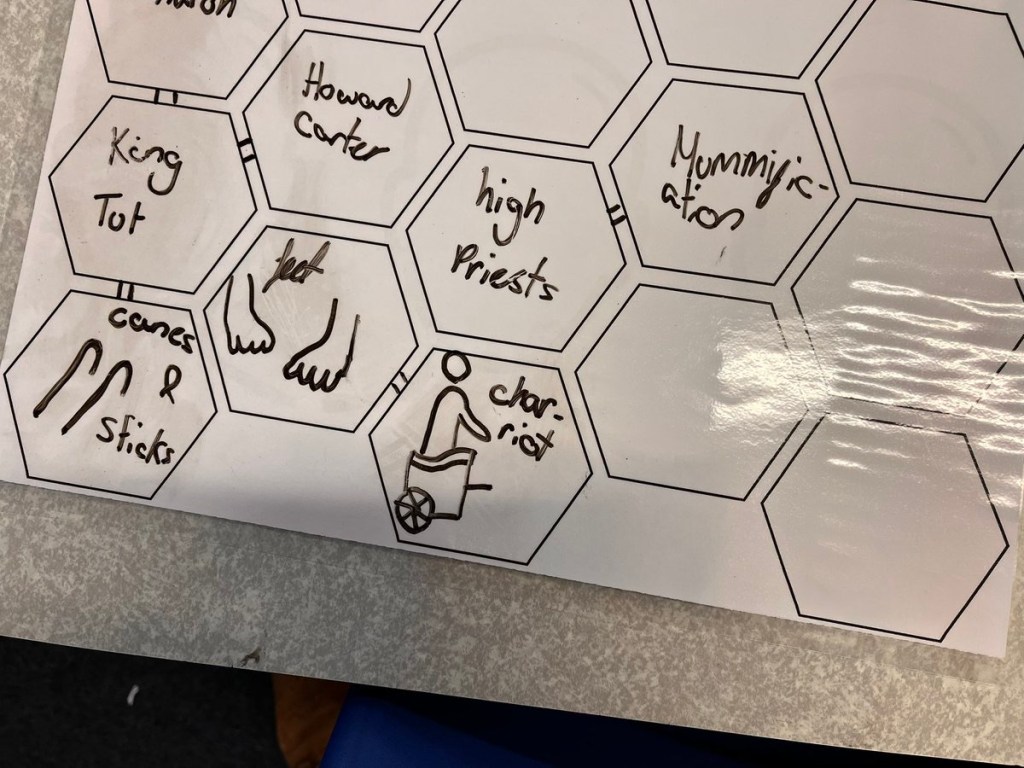
My journey into the use of these thinking models was further influenced by reading Extended Mind in Action by Emma Turner, David Goodwin, and Oliver Caviglioli, which led me to delve deeper into Annie Murphy Paul’s work on the “extended mind.” It’s become clear to me that providing students with a model or framework during tasks not only engages their thinking but also extends their cognitive abilities, allowing them to process and connect ideas more effectively.


Scaffolding the discussion is crucial in this approach. The graphic organiser helps students focus less on how to present their thinking and more on what they’ve learned and the connections between different pieces of knowledge. This became evident when the children began creating their own key for the hexagons, demonstrating a deeper level of engagement and ownership over their learning.

In addition to history, I’ve been experimenting with various other models, such as in our recent PSHE lesson. We used laminated thinking models to discuss and share qualities of a good friend. The students were then tasked with deciding which qualities were most, least, and not important. Once again, the use of a graphic organiser facilitated a more structured and meaningful discussion than a blank whiteboard ever could.


The takeaway from these experiences is clear: the use of graphic organisers as mini whiteboards leads to higher engagement with low stakes. It’s not a groundbreaking idea, nor is it entirely original, but it is undeniably effective. By providing students with a framework to organise their thoughts, we can foster deeper understanding and more active participation in their learning journey.

As we continue to explore the potential of these tools, I invite you to reflect on how you might incorporate graphic organisers into your own classroom practice. The possibilities for enhancing student engagement and extending their thinking are vast. Keep checking back to see how this approach evolves, and feel free to share your own experiences on X, BlueSky, Instagram, or Facebook. Let’s continue the conversation and collectively enrich the learning experience for our students.
Feel free to get in touch to offer feedback, constructive criticism, or ask any questions on Twitter (X) @MRMICT or on BlueSky.
Karl



 MRMICT
Leave a comment