Why Teaching Digital Citizenship and Online Safety is More Crucial Than Ever

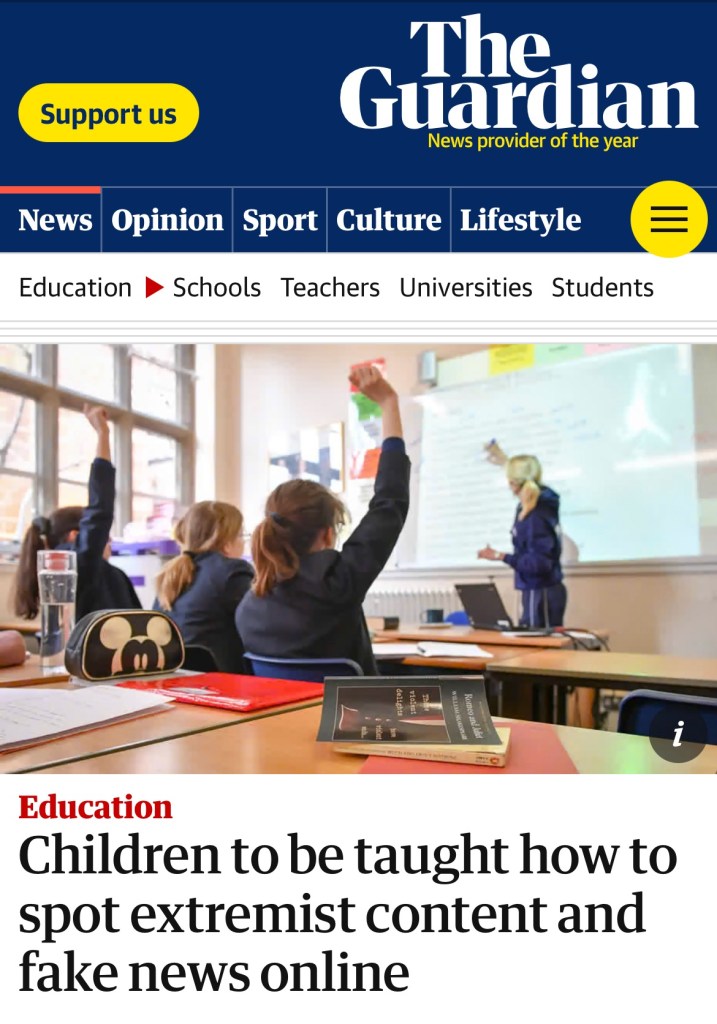
In recent days, headlines have been dominated by discussions surrounding the need for children in the UK to be equipped with the skills to identify extremist content and fake news online. The Guardian recently quoted the Education Secretary emphasising that “it’s more important than ever that we give young people the knowledge and skills to be able to challenge what they see online.” This statement is undeniably true, but it raises the question: is a curriculum review necessary to address the underlying issues, or is there a deeper problem at play?
Firstly, it’s incredibly important to ensure that children can confidently articulate what they know to be true, this requires knowledge. The old adage has never been truer, knowledge is power. The issue is that many articulate and media-savvy personalities are increasingly distorting the truth, treating knowledge and facts as if they are malleable and subjective. To effectively equip children with the weapons to challenge false information, it’s crucial that they are armed with a strong foundation of core knowledge in truth seeking subjects like science, history, and language. This ensures they have strong networks of existing information, making it easier to identify and refute falsehoods. Our schools curriculum is designed is such a way that our children are challenged to generate independent thoughts, however, back up and articulate through facts and what is proven and known to be true.
A glance at the current curriculum reveals that the groundwork for teaching online safety is already well established across various subjects. In the Computing curriculum, for example, students are taught to evaluate the reliability of online information and develop critical thinking skills from an early age. Key Stage 1 introduces the concept of using technology safely and respectfully, while Key Stage 2 explores how search engines rank and generate information, helping students understand that not all online content is trustworthy. By Key Stages 3 and 4, students are expected to critically assess digital content and recognise the risks associated with false information and “fake news.”
The English curriculum also plays a key role in this effort. Critical reading skills, which are essential for discerning the accuracy of information, are developed through activities that encourage students to question the credibility of sources and the way facts and opinions are presented. Writing tasks further reinforce these skills by requiring students to evaluate and integrate information from different sources, taking into account their reliability and potential biases.
PSHE (Personal, Social, Health, and Economic Education), though non-statutory, is widely taught and often closely linked with online safety. From Key Stages 1 through 4, students learn to differentiate between real-life and online representations, understand the dangers of sharing personal information, and critically evaluate the content they encounter on social media and other platforms.
Moreover, the non-statutory guidance on “Teaching Online Safety in Schools” and the annual updates to “Keeping Children Safe in Education” (KCSIE) provide comprehensive advice on integrating online safety into various aspects of the curriculum. These resources stress the importance of educating children about the motives behind misinformation, recognising different types of online risks, and developing the skills to verify the accuracy of the information they come across.
Despite this, the question remains: is more of the same truly the answer? While many schools dedicate significant time and resources to teaching online safety, the reality is that implementation varies widely. Some schools integrate online safety into weekly lessons, while others, like mine, devote an entire term to the subject with revisits throughout the year. Unfortunately, in some schools, online safety is only touched upon briefly during events like Safer Internet Day or assemblies.
The issue is not a lack of intent but rather the challenges of implementation. Time is a precious commodity in schools, and with so many competing demands, finding the right balance can be difficult. As we consider the need for a curriculum review, it is crucial to recognise that one of the greatest challenges is not the content itself but the time and resources required to deliver it effectively.
This is where resources like SWGfL’s (South West Grid for Learning) Project Evolve and Common Sense Media UK’s digital citizenship materials become invaluable.

Project Evolve offers a comprehensive toolkit that helps teachers weave digital citizenship and online safety into their teaching, providing age-appropriate resources that address the rapidly changing digital landscape. What’s more is that these resources are relevant. No more screenshots of mean things said by children, the resources have very relevant real life examples.

Common Sense Media UK similarly offers robust, research-based materials that guide children through the complexities of digital life, helping them develop the critical thinking skills needed to navigate the online world safely and responsibly.
However, while schools can provide the foundation for digital literacy, we need to acknowledge the limitations of what can be achieved in the classroom alone. There is a danger in expecting schools to fix all of society’s ailments by simply teaching a lesson about XYZ. The reality is that when children return home, they are often exposed to environments where inaccurate or false information is consumed and shared uncritically. This raises a critical question: how do we combat this issue? Can we reach every parent? How do we reach parents?
While schools play a crucial role in shaping the digital literacy of the next generation, the responsibility cannot rest solely on their shoulders. Parents and carers must be partners in this, reinforcing the principles of digital citizenship at home. Moreover, social media companies, as the effective publishers and distributors of information, have a significant role to play. They must take greater responsibility for curbing the spread of misinformation and disinformation on their platforms, ensuring that users—especially younger ones—are not exposed to harmful content.
It is important to remember that misinformation is not a new phenomenon; it has existed in various forms for centuries. What has changed is the way we tackle it. In the past, misinformation might have been limited to print or broadcast media, but today, the digital world amplifies its reach and impact. Our challenge now is to equip young people with the skills they need to navigate this complex information landscape, fostering a generation of critical thinkers who can discern fact from fiction and make informed decisions in an increasingly digital world.
Feel free to get in touch to offer feedback, constructive criticism, or ask any questions on Twitter (X) @MRMICT.




 MRMICT
Leave a comment