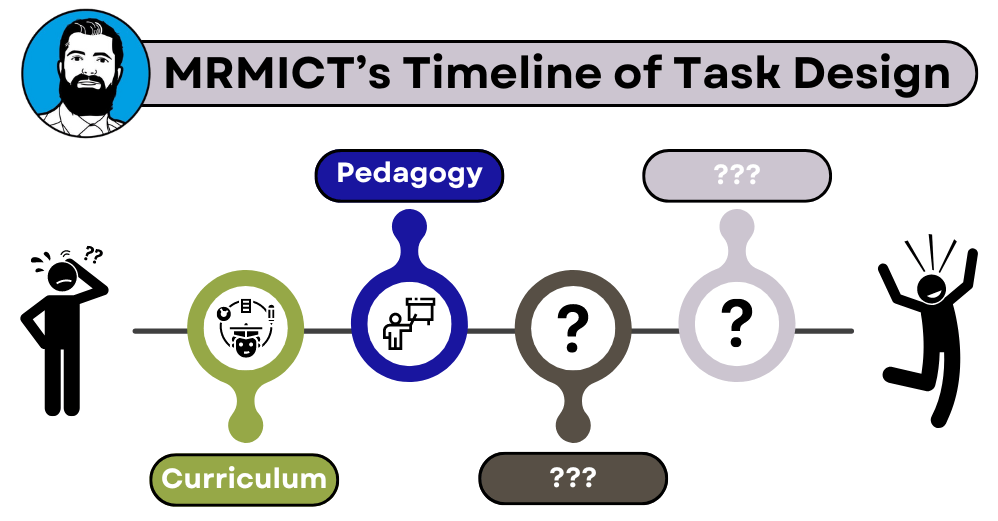
Before we start, if you haven’t already read the first blog in this series, I will include the link below for ease.
The purpose of this series is to shine a light on task design and highlight that effective task design has a lot more going on behind the scenes. For example, in the last instalment, I reflected on the need for a high-quality, knowledge-led curriculum, emphasising that we must be confident in what we want children to know and do. This is our curriculum.
In this episode, I want to delve into the importance of pedagogy. I have been thinking more about pedagogy lately and how much we underestimate pedagogical intent within task design. It’s always important to assert that you cannot have one without the other. Essentially, without a clear curriculum, you can’t have quality teaching because what are you teaching? However, a question I mulled over recently was: is a bad curriculum taught well better than a good curriculum taught poorly?
To me, it’s somewhat of an oxymoron; as I said, you can’t have one without the other. In designing effective curricula, we need to imagine how it should be taught, surely? Often, schools will assert their curricula are inquiry-based, exploratory, or use the mantle of the expert, etc. How can these models, or any for that matter, exist outside of great teaching? My claim here is not whether I agree or disagree with any of these approaches. I have been clear previously that I firmly believe a curriculum should be knowledge-led. You need knowledge to fuel inquiry, to explore without getting lost, and to know before you can imagine. Teachers need a basis to go on; whether we think one is better than the other is irrelevant.
With this in mind, if the curriculum is the recipe for the cake, effective pedagogy is the baker’s technique and skill in mixing the ingredients. Following the recipe precisely or adjusting as needed based on experience is what experienced and effective teachers do daily. There is an incredible renaissance in pedagogy and a wealth of blogs and CPD available to allow teachers to take control of their classroom practice. I’m not here to digest or disperse these in detail but to muse on my belief.
In my first placements, it was still insisted we have starter, main, and plenary within lessons. This is something that I understand from an ITT point of view, but it persists and continues to fuel misconceptions that lessons should exist within these episodes. My first placement mentor was adamant that effective teachers use pictures, songs, and videos to embed knowledge. This was then backed up by her belief that some learners learn visually—you know where I am going with this. LEARNING STYLES shudder. My mentor was a good teacher, misguided but good. The question is though, what is effective teaching?
Instructional Precision
It’s incredibly important to dull the noise when we start to consider what makes effective teaching. There is significant research; however, as always, there’s lots of noise. So going forward, to be clear, these are my opinions, granted based on my reading, but opinions nonetheless. Why? Because teaching, no matter how much we may think otherwise, is subjective.
Instruction is what we do, but can you be sure of whether you’re instruction is of quality? John Hattie’s extensive research in “Visible Learning” provides a comprehensive understanding of instructional quality, which is critical to effective teaching. Hattie identifies several key components to this including teacher clarity.
Teacher Clarity
Teacher clarity, with an effect size of 0.75, is crucial. This involves clearly communicating the content and providing understandable explanations. This is something I consider regularly. For example, do I give my class of year 6 the same definition of the word “adverb” as my year 3 colleagues do? I might say an adverb is a word that describes or gives more information about a verb, an adjective, or another adverb. However, we often hear that it’s a word with an -ly at the end, which, while sometimes true, is not always the case. Another example from maths: do I use the words “multiple” and “factors” correctly? Is it the same as others? You may think this seems a bit of an overreaction, but if we are all using the same definition, it gives clarity. With more clarity, I argue there’s less chance of misconceptions being embedded, similar to the -ly example. The evidence is clear: knowing what you are learning and being shown explicitly the ways to get there increases engagement and achievement significantly.
Rosenshine’s Principles of Instruction

Credit – Oliver Caviglioli
In addition to Hattie’s research, Barak Rosenshine’s “Principles of Instruction” provides a highly effective framework for quality teaching practices. These principles are grounded in cognitive science and classroom practices of master teachers, offering a comprehensive guide to what high-quality instruction looks like.
Daily Review

Rosenshine emphasises the importance of daily review to strengthen previous learning and connect new material to prior knowledge. This helps solidify memory and ensure foundational knowledge is secure.
This has morphed into retrieval practice, which in itself is not a bad thing. However, recently Clare Sealy stated, “retrieval practice limited to start of lesson quizzing,” and this is where retrieval practice of daily review is hugely misunderstood. Rosenshine was clear that children need to be engaged with daily, weekly, and monthly review to increase their fluency in recalling knowledge. Additionally, knowledge is sticky; the more we know and can connect, the better we can be as learners.
In addition to regular review, effective instruction involves breaking down complex material into smaller, manageable steps. This allows teachers to be flexible and adaptive with the children they teach. Providing smaller steps prevents cognitive overload and allows children to master each step before moving on to the next.
There is a caveat to this. In some cases, we can be unclear as to what the small steps are. Often, teachers will break knowledge or content into granular bites. This is effective if the subject content requires such minute detail; however, in other cases, the smallest steps aren’t needed and can have the opposite effect. There is enough evidence from Vygotsky to the expertise reversal effect to suggest that too small of a step can be counterproductive. This is where skilled teaching comes in. Knowing how and when to increase the difficulty over time takes practice, and teaching is a discipline we need to work at to get right.
Provide Models

Credit Tom Sherrington and Jamie Clark – https://www.jamieleeclark.com/blog/one-pagers
Teachers need to provide clear models and worked examples to demonstrate the application of new knowledge. This is something I think about particularly in task design; models are incredibly important, whether these are graphic organisers or a way to extend the mind beyond the abstract.
One tangible point I make about models is when setting out my work on my whiteboard, I was always annoyed when the children’s work never looked like how I’d “modelled.” The problem was my whiteboard was not a book, so now using a visualiser and a modelling book has instantly improved the quality of my instruction. With clear and careful modelling, children understand the processes, and it sets a clear standard for quality work.
Direct Instruction

Credit – Oliver Caviglioli https://www.olicav.com/blog/2018/5/15/direct-instruction
I’m going to be bold, and some may disagree, but I am NOT a fan of inquiry-based or exploratory approaches. Why? Inquiry-based learning can be valuable in encouraging group work, critical thinking, and problem-solving; however, the lack of structure hinders the development of knowledge. Ultimately, if you don’t know, you can’t inquire well enough.
A basic understanding of Cognitive Load Theory suggests that inquiry-based learning can overwhelm children, especially novices, with excessive information and complex tasks. Moreover, the amount of continuous modelling, guided support, and out-loud thinking for it to be successful is unrealistic.
Here’s why direct instruction is more effective: teachers explicitly teaching content and strategies through a structured, systematic process allows for the careful building of knowledge.
Teacher clarity is key, as I have mentioned above. However, it is important to provide carefully structured chunks of well-thought-out knowledge, considering prior knowledge (or sometimes the lack of prior knowledge), as well as providing non-examples. Something I often forget is that when providing a definition, I rarely share what it is not.
When we celebrate the success of the children, we need to be thoughtful about it. Yes, this can amount to saying, “Well done, I see you tried incredibly hard yesterday.” However, feedback, which is what celebrating success is, works best when we provide clarity and specifics about what was working well and what led to the success. Ron Berger and Austin’s Butterfly show how incredibly important it is to be clear and specific with our feedback and celebration of success.
Adaptive Teaching
I would be completely remiss if I neglected to talk about the importance of adaptations, flexible teaching, and adaptive teaching. Often, people ask, “What do you give your SEND children?” or “Do all the children do the same task?” The answer is that all children access the same task, but how? Through adaptive teaching. I am not going to go into great detail here, as it has been better articulated by Clare Sealy in her recent mammoth blog – Adaptive Teaching – the four verbs approach which you can access below.
Clare also used tasks, which I have credited, to illustrate some of her points. The point is that with a carefully thought-out curriculum and clear, practiced pedagogy, the ‘task design’ addresses many of the adaptations needed to include all students. Differentiation is not about different tasks for different children; it is about thinking how all children will access the same task, with high challenge and low threat.
https://www.marymyatt.com/blog/high-challenge-low-threat
End
In summary, effective teaching combines clarity, structured instruction, positive relationships, and feedback with strategies that promote deep understanding and self-regulation. By integrating these elements, teachers can significantly enhance student learning and achievement.
Join me again for the next episode of this: Task Design Timeline.
Feel free to get in touch to offer feedback, ‘kind’ criticisms or to ask any questions on Twitter (X) @MRMICT. If you are keen to share in my seeming mission to improve the discussion or discourse around ‘task design’ then join our growing Facebook group.

Karl




 MRMICT
Leave a comment