
It is the missing piece…
It’s been a while since I had both the time and will to write a blog post, however, since starting in my new role I felt excited and compelled too, here’s why.
My role this year is ‘Curriculum Task Design Lead’. When preparing for the selection process which usually involves a combination of research into the school, their curriculum and their approach, I also did some ‘Task Design’ research. What I found, and someone is welcome to correct me, was that there seemed to be very little research out there. I did find some though and those that I found were great, particularly the work of Tom Sherrington and Elliot Morgan. It’s worth noting that we use the word task a lot and often neglect to think about what children will think. Commonly we describe tasks as what the children do, but it is more than just the final thing. So it seemed to me that this is a little ahead of the curve. I have seen others do similar roles like teaching and learning lead, however, having now been in the role for a full year now I assure you it isn’t.
I suppose now is a good time for a disclaimer, task design is happening every day up and down the country. What I have observed though both on #edutwitter and across local schools is that most of the task ‘design’ focuses purely on children completing work. Hopefully we all know by now that this is a poor proxy for learning. Whereas for me, task design is a fine balance, one which tows the line delicately along thinking and practice.
However, in leading task design and meeting others through teach meets and chatting on Twitter, there is a real desire or willingness to do better and design better tasks.
But what is it really?
The best question to ask here is not what is it but why do we give ‘tasks’ or what are they? For me previously, a task was just something children did at the end of a lesson that showed they understood the learning and if I’m really honest I barely gave it much thought and I don’t really think they understood the learning either. There was either some form of drawing or some form of writing and it barely moved beyond the ‘unistructural’ or ‘multistructural’… more on those terms in a bit.
At its simplest, task design is the thing we give the children that enables them to engage in their learning. We are incredibly time poor as teachers. As a primary teacher I feel planning multiple lessons across a variety of disciplines is hard. In my 2.5 hours of PPA I have to remove my historian hat, then pop on my literary cap, to suddenly move in to acting or thinking like a social scientist and while I love every second of it there’s no denying the pitfalls. However, we would be lying if we said we didn’t just tweak last years lesson because you didn’t have time to think about it anymore.
Taxonawho?
I know Blooms Taxonomy isn’t exactly in vogue even though, however, I find it helps me to think about questions to inspire some deeper thinking. I am though an unapologetic fan of the SOLO Taxonomy model by John B. Biggs and Kevin F. Collis. It was introduced to me by my Headteacher Dominic Martin.
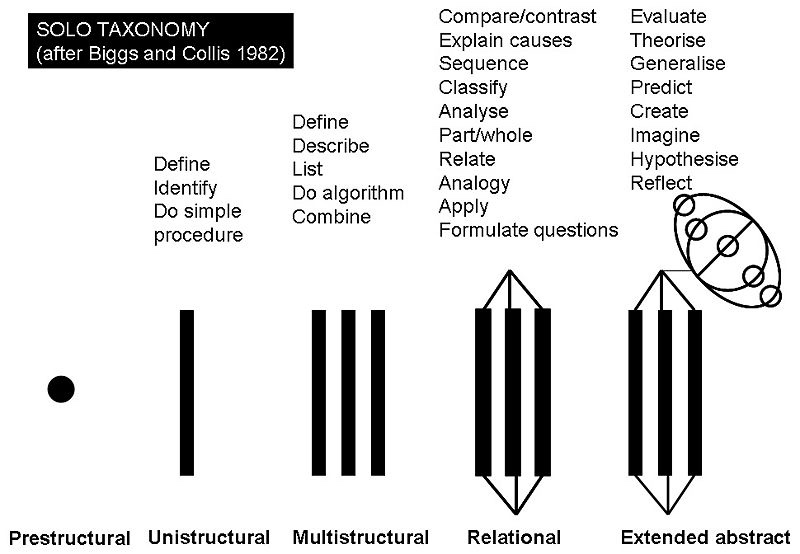
It was here that I was introduced to using hexagons as a way to connect ideas in a concept map or ‘hexagonal thinking’. I delved a bit deeper into the work of Pam Hook the director of HookED. She developed a unique classroom based approach to SOLO Taxonomy (Biggs and Collis 1982).
A task that’s great for forming connections and proving links. This is also something that Alex Bedford and CUSP schools use to scaffold, link and explain paths or connections between ideas. I digress though, my introduction to Blooms and SOLO is where the ember of task design began for me.

What is ‘effective’ task design?
Now in order to have effective task design make no mistake that there needs to be an incredibly thoughtful and well designed curriculum at its heart. I wasn’t involved in the development of my school’s curriculum but it is brilliant! It’s well thought out, it has depth and it is the progression model. Each new concept builds on that which came before and key strands weave through disciplines. It is important for me to make clear that there was a lot of work beginning on this, as curriculum leaders and teachers were already asking ‘What does the curriculum look like in the classroom?’ at my school before I joined and all that I share and reflect upon here is the culmination of my working within an incredible team of thoughtful and reflective practitioners.
Before…
In my previous school, I used to think that what I was doing or what I was giving the children to work with was good and some of it was. We had some training on metacognition and as a result we had started using a ‘thinking toolkit’ which is definitely a great place to start. It included things like inference squares, opinion lines and concept maps to enable thinking around new learning. However, that will only take you so far and as I said it really only gets you beyond the ‘relational’ aspect of solo taxonomy.
As I’ve been reflecting on my practice and leadership this year, there have been a number of authors and some critical research that has shape my thinking around task design. First is ‘Generative Learning’ by Logan Fiorella and Richard E. Mayer as well as ‘Extended Mind Theory’ by Annie Murphy Paul. Before this, I relied heavily on the work of Tom Sherrington, Oliver Caviglioli and David Goodwin, and their books The teaching Walkthru’s and Organise Ideas. In being able to see my teaching and tasks for what they are Alex Bedford and Pupil Book Study has really helped me to see how clear and meaningful learning has to be in order for it to stick. The picture below might help you arrange some possible reading material.
Picture
I have also engaged with some incredible educators on Twitter that have challenged me to think differently about Task Design. In no particular order Pete Richardson @primarypete_, Elliot Morgan @MorgsEd, Johnny Hemphill @worcesterjonny, Derrick Roberts @MrRobHistory, Tom Sims @tommole
There will no doubt be many missed and I’m sorry if that’s the case 🤦🏻
It is hard fo me to articulate what it is that I believe is effective task design. However, the process for me starts with what the children are learning. I have been asked a few times this year to plan ‘task design’ from start to finish so, rather than narrate excessively, its probably best for me to retrospectively plan my task. Let’s start with the concept.
FAITH in PRACTICE
HOW DO ETHICS CHANGE HOW WE SEE THE WORLD?
This was the third lesson, as part of a sequence, on the difference between faith and belief. We were having lots of conversations around disciplinary thinking and how we can ensure that we are planning lessons and task with this in mind. This lesson was focussed more on the way in which Buddhists might see the world and how it could change their ethics or how they interact with others and situations as a result of their ethics. In summary, below is what the lesson ‘content’ looked like:
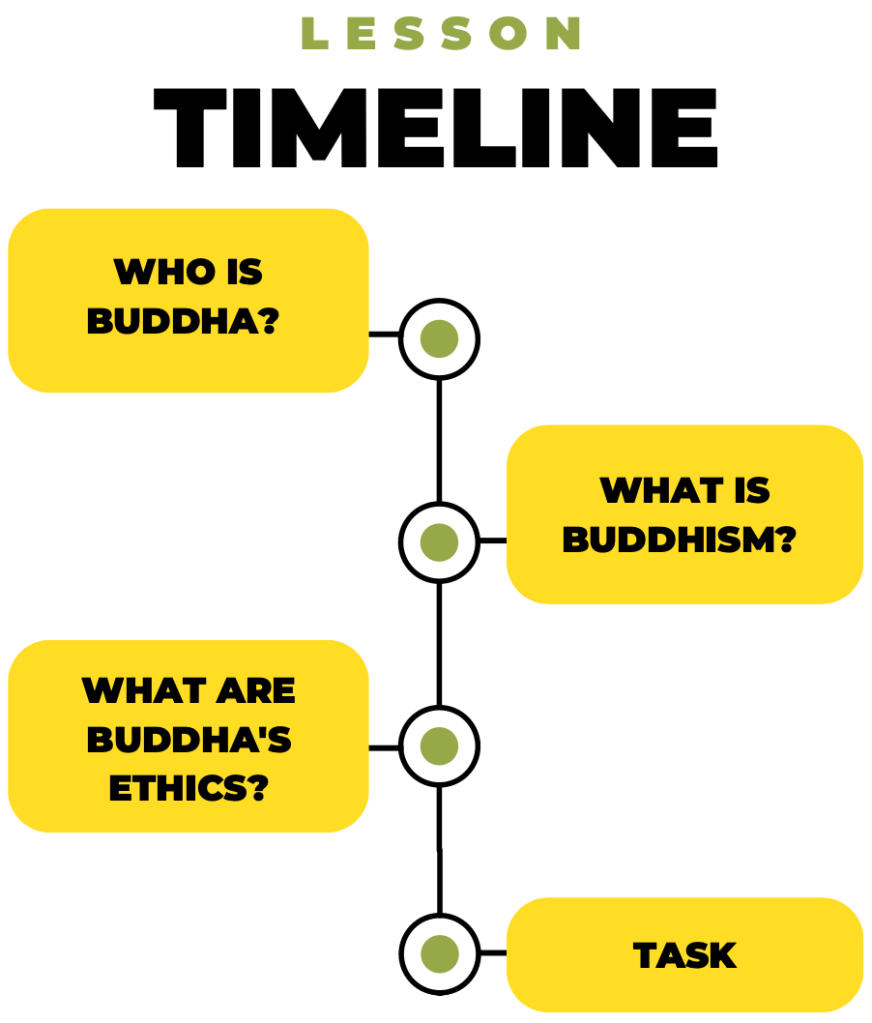
Who was Buddha? We watched a retelling of Buddha’s story and discussed his upbringing as well as the experiences that made him behave and teach in the way that he did. We then looked at how Buddha’s followers were impacted by his teachings, the way in which he taught and how this challenged his and his followers ethics.
After this we started to look at a short case study… again I found a really helpful animated video from the BBC that helped us discuss the implications of Buddha’s actions, thoughts and decisions.


This was then distilled further into a dilemma – do – notice – learn format which allowed me to scaffold the process that we wanted to get across.
Scenario or Dilemma

Sila – ethics -/+ve behaviour – What do you do/think?
Samadhi -/+ve states of mind – What do you notice?
Prajna -/+ve life changes = wisdom – Do you learn anything?
The sticking point for me was what task would illustrate this or at least help the children ‘extend their thinking’ and understand a fairly complex idea. I talked it through with my head Dominic Martin who is also our RE lead, I had decided the task should reflect the model he had shared seen below:

I liked the cyclical design and felt if the children had to essentially follow this path then they would be able to understand better. This then led me to design a similar flow an idea borrowed from Organise Ideas.
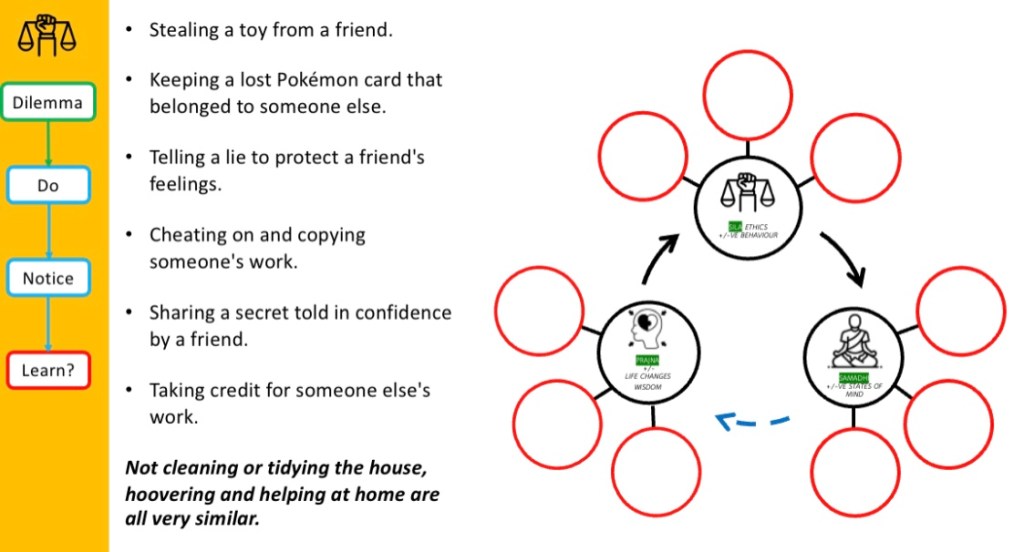
Thus the task was born. The idea was simple, in response to a dilemma what is the ethical problem at play? We then asked what might we do or notice as a result? I included a dashes arrow on purpose and the idea here was to illustrate that we don’t allows make appropriate choices and thus our ethics are flawed. Now it might seem complex but the children really did get it! I would argue that the combination of laser focussed knowledge and progression from the subject lead and my task design modelling and externalising the disciplinary thinking really got the children there.


What next?
For me the next step is to think deeper about it? So now that we have unpicked some specific ‘ethical dilemmas’ how do we overcome these or if our state of mind changes what is it that stops us from making the ‘right’ choices. So this lesson was a deep one, but my class are Year 5 and they definitely understood Buddha’s approach, what we ‘achieve’ by following this approach and how not everyone can move onto a particular state of mind in which case that person needs to return to their ethical core.
So what on earth had this got to do with task design?
This is task design. It can be argued or articulated differently by others but to me task design incorporates an element that allows the children to interact or externalise their thinking around an idea. This can also allow for manipulation, discussion and ultimately bring meaning to themselves because as a constructivist concept ‘meaning is made in the mind of the learner’. Then, it’s the ability to synthesise this into their on schema, this is where a well designed curriculum comes in. If you have structured your curriculum in a way to allow for new ideas to build on existing ones and make strong, clear and meaningful connections then you are on the right track. Finally provide questions or tasks that get the children to think deeply about their learning. Taking the lesson above here are some examples of the types of questions I mean:
• What would the impact of positive behavior and Samadhi be on an individual’s well-being and relationships?
• What is wisdom and does it play an important role (Prajna) in making ethical decisions in life?
Now these would be discussed and I would allow the children to form their arguments. However, these types of questions for me allow the children to access the learning at a deeper level.
Do all access it?
The goal is for all learners to access all elements of a lesson and the core learning. I would argue that our children do and they’re thinking about their learning. What they offer in terms of ‘outcomes’ in their book might not reflect it, but I have seen clear evidence of their ability to articulate their understanding.
Conclusions
Ultimately, you will draw your own. I wrote this as s way for me to sum up or ‘externalise’ my own experience this past year lead Curriculum Task Design in earnest.
I’m a nutshell task design is the next phase in curriculum development. Schools as a result of the (not so) new Ofsted framework have been developing their curriculum but what does that look like in practice? How do the children show what they know?
It’s definitely not as articulate as my contemporary Elliot Morgan but hopefully it’s of use to others. I had been asked a number of times for advice, tips or what it is I do and although, yes, my tasks ‘look good’ for me there’s thinking and a point to why I design them in the way I do. It won’t be everyone’s cup of tea and even locally, I have had some teachers say that it restricts the opportunity for ‘extended cross curricular writing’, I argue that children writing a news report or diary entry about a historical event or geographical phenomena is diluting the learning.
Feel free to get in touch to offer feedback, ‘kind’ criticisms or to ask any questions on Twitter (X) @MRMICT
Final thought, think about what you’re giving the children and good luck.
Karl



 MRMICT
Leave a comment